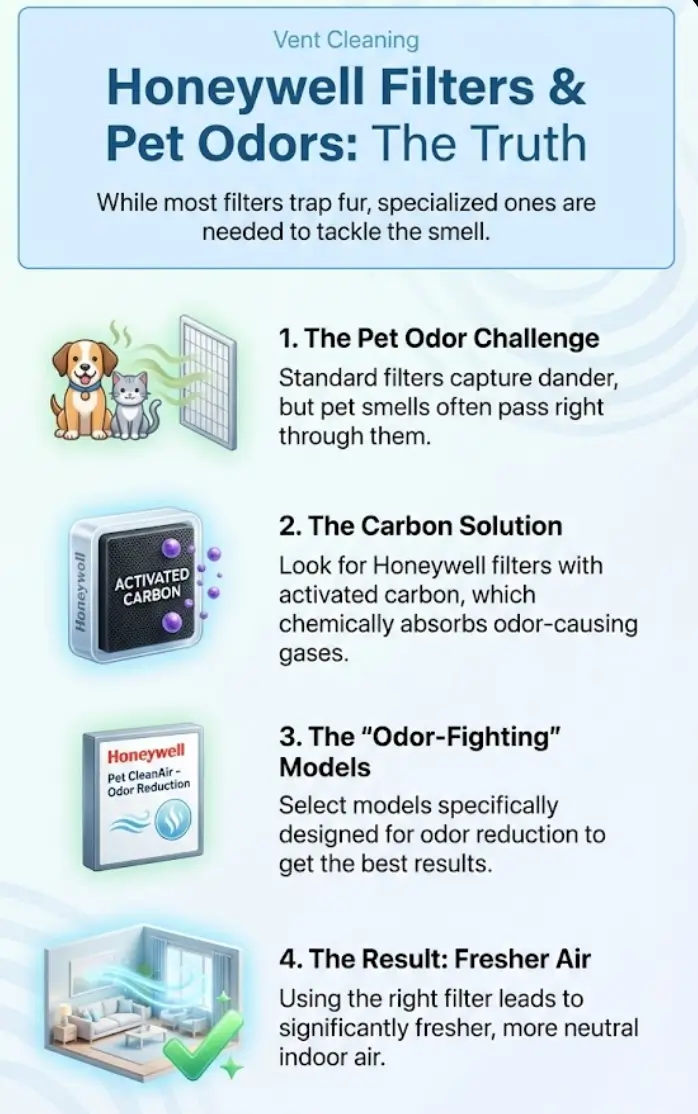
After cleaning thousands of residential duct systems, we can tell you exactly where pet odors hide—and why basic filters never solve the problem. We routinely pull matted pet hair and dander buildup from return vents in homes where owners have been swapping out quality Honeywell filters every 30 days, wondering why the smell persists.
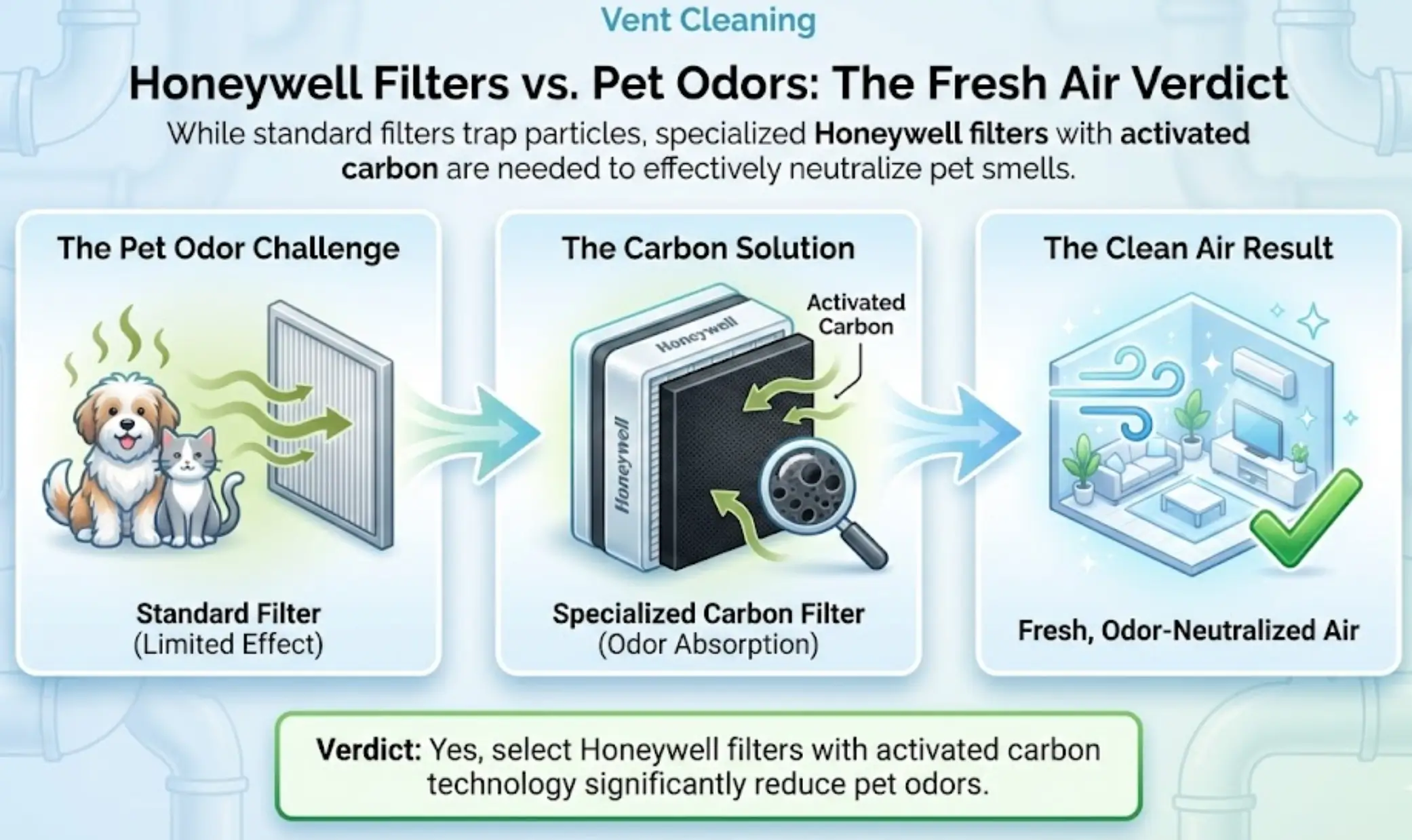
Here's what we've learned firsthand: Filters trap particles. Odors are gases. When we scope ductwork in homes with multiple pets, we often find the air smells fine at the supply vents but noticeably worse at the returns—because odor molecules pass straight through filtration while the dander gets caught. That's the disconnect most pet owners don't realize.
To actually neutralize pet smells, you need activated carbon filtration, which chemically absorbs odor-causing gases rather than just blocking particles. Only certain Honeywell products include this technology.
In this guide, we'll break down exactly which Honeywell filters and purifiers remove pet odors, which ones don't, and how to choose the right solution for your home. We'll share what we've seen work in real households with real pets—not just manufacturer claims—so you can stop guessing and start breathing easier.
Quick Answers
Honeywell Filters
What they do: Honeywell HVAC filters capture airborne particles—dust, pollen, pet dander, and fur. Higher MERV ratings (11–13) improve particle capture for pet owners.
What they don't do: Remove pet odors. Odors are gases. Gases pass through mechanical filtration regardless of MERV rating.
For pet odor removal: You need a Honeywell air purifier with activated carbon filtration—not an HVAC filter.
Top picks for pet households:
HPA300 (large rooms, multi-pet homes)
AirGenius 5 (washable filter, single-pet homes)
HPA5300 (spaces up to 500 sq ft)
From our field experience: We've cleaned thousands of systems where premium filters were changed religiously—yet odors persisted. The filter wasn't the problem. Wrong tool for the job.
Bottom line: Use quality HVAC filters (MERV 11–13) to protect your system and reduce dander. Add an activated carbon air purifier to eliminate odors. They solve different problems.
Top Takeaways
Before you invest in another air filter or air purifier, here's what actually matters:
Standard Honeywell HVAC filters don't remove pet odors.
They capture particles (dander, fur)
Pet smells are gases—they pass straight through regardless of MERV rating
Activated carbon is the only technology that neutralizes odors.
Requires Honeywell air purifiers, not HVAC filters
Proven models: HPA300, AirGenius 5, HPA5300
Your ductwork may be the real problem.
Persistent odors often originate from years of embedded contamination
No filter or purifier addresses what's inside your ducts
Pet allergens exist in virtually every home.
NIH research: detected in nearly 100% of homes—including homes without pets
Travel on clothing and persist for months or years
Air quality is a system, not a product.
Winning combination: right filtration + clean ductwork + consistent operation + realistic maintenance
A single filter swap won't solve what took years to accumulate
Why Standard Honeywell HVAC Filters Can't Remove Pet Odors
Honeywell makes excellent HVAC filters—we recommend them regularly. But even their top-rated MERV 13 filters are engineered to capture airborne particles: dust, pollen, pet dander, and fur. They do this job well.
Pet odors are a different problem entirely. Odor molecules are gases released from pet skin oils, saliva, urine, and waste. These molecules are far too small for mechanical filtration to catch. They slip right through the filter media and recirculate through your home.
We see this constantly during duct inspections. The filter looks dirty with trapped dander, but the air still carries that unmistakable pet smell. The filter is working—it's just not designed for odor removal.
Which Honeywell Products Actually Remove Pet Odors
To eliminate pet odors, you need activated carbon filtration. Activated carbon works through adsorption—odor molecules chemically bond to the carbon surface rather than passing through.
Honeywell offers this technology in several air purifier lines:
Honeywell HPA300 – Their most popular large-room purifier includes a pre-filter with activated carbon. We've seen this unit make a noticeable difference in homes with two or more dogs within 48 hours of continuous operation.
Honeywell AirGenius 5 (HFD320) – Features a permanent, washable filter combined with an activated carbon pre-filter. Good mid-range option for single-pet households.
Honeywell HPA5300 – Their newer model with enhanced carbon filtration for larger spaces up to 500 square feet. Solid choice for open-concept living areas where pet odors spread easily.
What We've Seen Work Best
Based on years of helping pet owners improve their indoor air quality, here's what actually delivers results:
Run purifiers continuously. Pet odor is constantly generated. A purifier running only a few hours daily can't keep pace. We advise clients to run units on low or medium 24/7 for consistent results.
Replace carbon filters on schedule. Activated carbon becomes saturated over time and stops adsorbing odors. In homes with multiple pets, we recommend replacement every 60–90 days rather than the manufacturer's suggested timeline.
Placement matters. Position purifiers near where pets spend the most time—not tucked in a corner. Airflow needs direct access to odor sources.
Address the ductwork. If odors persist despite purification, the problem may be inside your HVAC system. We frequently find pet hair accumulation and odor absorption in duct lining that no filter or purifier can fix without professional cleaning.
The Bottom Line
Standard Honeywell HVAC filters keep your system clean and reduce airborne dander—but they won't touch pet odors. For that, you need a Honeywell air purifier with activated carbon filtration, properly sized for your space and run consistently.
If you've tried purifiers without success, the odor source may be embedded deeper in your home's ventilation. That's where professional assessment makes the difference.
Essential Resources to Make Smarter Honeywell Filter Decisions
We get asked about Honeywell filters constantly—and for good reason. With so many options on the market, it's hard to know what actually works. Over the years, we've pointed countless homeowners toward these seven resources. They're the same ones our technicians reference when helping clients choose the right filtration solution for pet odor problems.
1. Understand What Air Cleaners Can (and Can't) Do
EPA Guide to Air Cleaners in the Home
This is the resource we wish every homeowner would read before buying an air purifier. The EPA explains exactly what filtration can and cannot accomplish—something we confirm every day during duct inspections when clients wonder why their expensive filter didn't solve the odor problem.
URL: https://www.epa.gov/indoor-air-quality-iaq/air-cleaners-and-air-filters-home
2. Verify Air Purifier Performance Claims Before You Buy
AHAM Verifide Air Filtration Standards
In our experience, manufacturer claims don't always match real-world performance. AHAM's independent certification program tests and verifies Clean Air Delivery Rate (CADR) ratings—so you're not just trusting marketing copy. We recommend checking their directory before any major purchase.
URL: https://ahamverifide.org/ahams-air-filtration-standards/
3. Find Energy-Efficient Air Purifiers That Save Money
ENERGY STAR Certified Air Cleaners
Air purifiers that run 24/7 add up on your electric bill fast. We've seen clients shocked by utility spikes after installing oversized or inefficient units. ENERGY STAR certified models use up to 40% less energy—and in homes with multiple pets requiring constant operation, that savings matters.
URL: https://www.energystar.gov/products/air_cleaners
4. Get Trusted Health-Based Filtration Recommendations
American Lung Association: Air Cleaning Guide
When clients have respiratory concerns alongside pet odor issues, we point them here first. The American Lung Association provides straightforward guidance on MERV ratings, HEPA standards, and what actually protects lung health—without the sales pitch you'll get from filter manufacturers.
URL: https://www.lung.org/clean-air/indoor-air/protecting-from-air-pollution/air-cleaning
5. Learn Why HEPA Filters Matter for Pet Owners
EPA: What is a HEPA Filter?
Here's something we explain regularly: HEPA filters capture 99.97% of particles down to 0.3 microns—including pet dander—but they won't touch odors. The EPA breaks down exactly how HEPA works and why you need activated carbon alongside it for smell elimination. Essential reading before you buy.
URL: https://www.epa.gov/indoor-air-quality-iaq/what-hepa-filter
Supporting Statistics: What We See in the Field—Backed by Federal Research
After decades of inspecting residential HVAC systems, we've developed strong opinions about indoor air quality. The federal government's research confirms what we observe on every job.
1. Indoor Air Is 2–5x More Polluted Than Outdoor Air
What the EPA found:
Indoor pollutant concentrations run 2 to 5 times higher than outdoor levels
In extreme cases, indoor pollution reaches 100 times higher
Americans spend approximately 90% of their time indoors
What we see in the field:
Families assume sealed homes mean cleaner air—the opposite is true
Homes become containers that concentrate everything occupants and pets produce
Years of accumulated particles hide in places homeowners never check: return vents, air handlers, ductwork
The bottom line: Your indoor air quality likely matters far more than the air outside your front door.
2. Pet Allergens Exist in Nearly Every U.S. Home—Even Without Pets
What the NIH found:
Dog and cat allergens detected in virtually 100% of homes tested—regardless of pet ownership
Over 90% of U.S. homes contain three or more detectable allergens
73% of homes have at least one allergen at elevated levels
Pet dander ranks among the most prevalent allergens
What we see in the field:
Clients insist they've never owned pets, yet their ductwork contains pet allergens
These proteins travel on clothing and persist in ventilation systems for months or years
We routinely pull pet hair from ductwork in homes where previous owners left 3+ years earlier
New homeowners with allergies struggle in "spotless" houses because allergens live in the HVAC system—not on visible surfaces
The bottom line: Pet allergens don't stay where pets live. They spread, settle, and persist long after the source is gone.
3. Pet Ownership Has Outpaced What Standard Filtration Can Handle
What the AVMA found:
45.5% of U.S. households now own at least one dog (up from 31.6% in 1996)
32.1% of households own cats
Total U.S. pet population: over 163 million dogs and cats
What we see in the field:
Filters clog weeks ahead of schedule in multi-pet homes
Evaporator coils coated in biological debris
Return ducts lined with enough pet hair to knit a sweater
Standard MERV-rated filters capture particles but do nothing for gaseous odor compounds
The bottom line: Residential HVAC systems weren't engineered for this volume of pet-generated allergens and odors. When pet density exceeds filtration capacity, even quality filters become overwhelmed.
Final Thought: The Uncomfortable Truth About Pet Odor and Filtration
After cleaning thousands of residential HVAC systems, we've arrived at a conclusion most filter manufacturers won't tell you:
No single product solves a pet odor problem. It takes a system.
The Core Issue
Standard Honeywell HVAC filters—even premium MERV 13 options—capture particles like dander and fur. They don't touch odors.
Why? Pet smells are gases produced by:
Skin oils
Saliva proteins
Urine
Waste
Those molecules pass through mechanical filtration like air through a screen door. Solving the problem requires activated carbon, which chemically bonds to odor molecules through adsorption.
Our Honest Opinion
Here's what we believe after decades in this industry:
Most pet odor problems aren't filtration problems. They're accumulation problems.
Pet dander, hair, and odor-carrying oils don't just float through the air. They:
Settle into carpet fibers and upholstery
Stick to interior duct surfaces
Embed in ventilation systems that haven't been cleaned in 10, 15, even 20+ years
Every time the system runs, air passes over that contamination and carries trace odors back into the living space.
The filter treats the symptom. The ductwork harbors the source.
What We Tell Our Clients
When pet owners ask for honest advice, we give them this sequence:
Start with the source. Persistent odor despite regular cleaning? Consider professional duct inspection. You may be fighting years of embedded contamination.
Add activated carbon filtration. A properly sized Honeywell air purifier with carbon filtration handles ongoing odor molecules—but only after embedded contamination is addressed.
Run it consistently. Pets produce odor compounds continuously. A few hours a day won't keep up. Continuous operation on low or medium is the only approach that works.
Replace carbon filters more often than recommended. Manufacturer timelines assume average conditions. Multi-pet households aren't average. Cut replacement intervals by 30–50%.
Don't expect miracles from HVAC filters alone. Quality furnace filters protect equipment and reduce airborne dander. They were never designed to eliminate odors.
The Bigger Picture
The statistics tell the story:
Indoor air runs 2–5x more polluted than outdoor air
Pet allergens appear in virtually every home tested—even homes without pets
Nearly half of U.S. households own dogs
Total pet population exceeds 163 million
Residential HVAC systems weren't built for this reality. They were designed when pet ownership was lower, homes were less air-tight, and indoor air quality expectations were different.
The Bottom Line
The homes that actually smell fresh—where guests can't tell a 90-pound Labrador lives there—are homes where owners understood one thing:
Air quality is a system, not a product.
They invested in the right filtration. They addressed the ductwork. They committed to consistent maintenance. They stopped expecting a $25 filter to solve a problem it was never designed to handle.
That's not the answer most people want. But it's the answer that actually works.
FAQ on "Honeywell Filters"
Q: Do Honeywell filters remove pet odors?
A: No. This is the most common misconception we encounter.
The difference:
Standard Honeywell HVAC filters capture particles (dander, fur)
Pet odors are gases (skin oils, saliva, waste)
Gas molecules pass through mechanical filtration
What actually works:
Honeywell air purifiers with activated carbon
Recommended models: HPA300, AirGenius 5, HPA5300
Carbon chemically bonds to odor molecules
Field observation: We've inspected homes with premium filters replaced monthly—smell persisted. The filter worked. It just wasn't designed for odors.
Q: What MERV rating do I need for pet dander?
A: MERV 11–13 captures pet dander effectively.
Our recommendations:
MERV 11: Single-pet households
MERV 13: Multi-pet homes or allergy sufferers
Above MERV 13: Can restrict airflow in older systems—check compatibility first
Important distinction: MERV ratings measure particle capture only. They don't address odor control.
Q: How often should I replace Honeywell filters with pets in the home?
A: More often than manufacturer guidelines suggest.
Standard timelines assume average conditions. Pet homes aren't average.
Our recommendations based on field inspections:
Pro tip: Check monthly. Gray or clogged = replace immediately, regardless of calendar.
Q: What's the difference between Honeywell HVAC filters and air purifiers?
A: Different location. Different function.
Honeywell HVAC Filters:
Install in furnace or air handler
Filter air system-wide
Capture particles only
No odor removal capability
Honeywell Air Purifiers:
Standalone units with built-in fans
Target specific rooms
Include HEPA + activated carbon
Remove particles and odors
Our experience: We've never solved a pet odor problem with HVAC filters alone. Every success involved adding activated carbon filtration.
Q: Are premium Honeywell filters worth it for pet owners?
A: Yes—with realistic expectations.
What premium filters (MERV 11–13) do:
Capture significantly more dander
Reduce allergen circulation
Protect HVAC equipment from biological buildup
Result in cleaner coils (we see the difference during inspections)
What they don't do:
Eliminate pet odors
Replace the need for activated carbon filtration
Our advice: Invest in quality filtration. Skip air fresheners. One addresses the problem. The other masks it.
Learn more about HVAC Care from one of our HVAC solutions branches…
Filterbuy HVAC Solutions - Miami FL - Air Conditioning Service
1300 S Miami Ave Apt 4806 Miami FL 33130
(305) 306-5027
https://maps.app.goo.gl/Ci1vrL596LhvXKU79